
The worry people bring to a first Botox appointment is rarely the needle. It is looking frozen, or looking obviously treated, or ending up with an expression that is not theirs. That concern is reasonable, and it comes down almost entirely to dosing and placement rather than the product itself.
At Summit Plastic Surgery in Redding, CA, Botox is delivered conservatively and mapped to how your face actually moves. We would rather start lower and add at a two-week review than aim for maximum effect on the first visit, because adding is straightforward and removing is not possible.

Botox is a purified form of botulinum toxin type A used to temporarily relax the specific muscles that create dynamic wrinkles. Dynamic means the lines that appear or deepen when you move, as opposed to lines visible when your face is completely at rest.
It works on the signal rather than on the skin. Injected into a targeted muscle, Botox interrupts the nerve signal telling that muscle to contract. The muscle relaxes; it stops folding the skin above it with every expression, and the lines formed by that repeated folding soften over the following days.
On the regulatory position, since it is worth being precise: Botox is FDA-approved for frown lines between the brows, crow’s feet, forehead lines, and severe underarm sweating. It is also used for other areas of the face and neck on an off-label basis, which is legal and routine in aesthetic practice. Your provider will explain which category your treatment falls into.
Botox addresses one specific thing well: lines caused by muscle movement. The points below reflect what it actually offers rather than what it can be made to sound like.
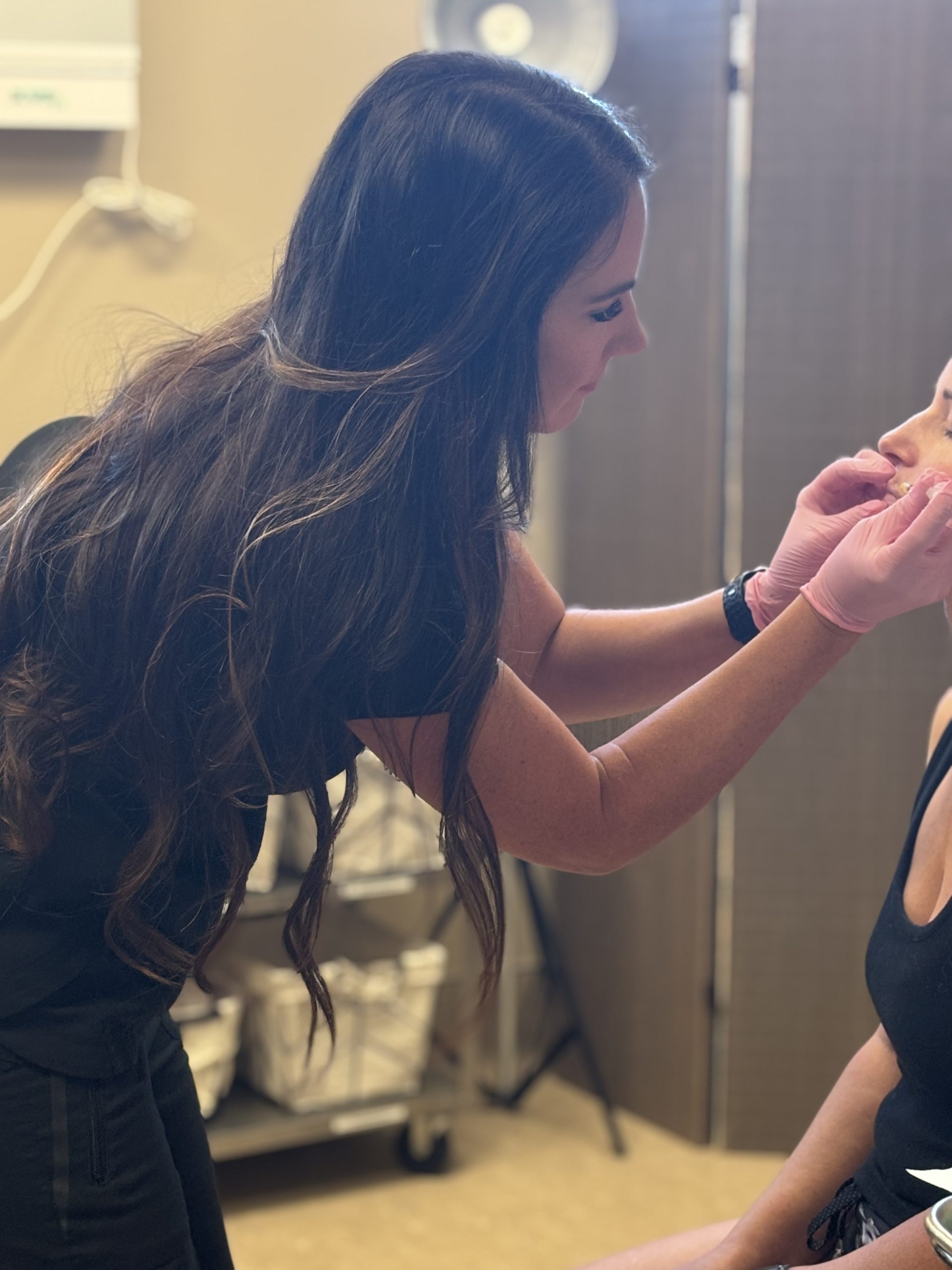
Treatment involves a series of small injections placed into specific muscles, with the number and placement mapped to your facial anatomy rather than applied from a standard template. The appointment takes under thirty minutes and needs no numbing.
Nothing changes on the day itself. Softening begins around three to seven days as the product takes effect, and the full result settles at about two weeks. That two-week point is the right time to assess your outcome, and it is also when a small addition can be made if an area needs more.
The effect wears off gradually over three to four months as nerve signaling returns. Patients who treat consistently often find the muscles weaken over time, which can mean fewer units are needed, or appointments can be spaced further apart.
Botox is used wherever muscle activity creates a line, alters a contour, or drives a functional problem. Placement and dose are mapped to your anatomy rather than applied uniformly.
Softens the horizontal lines created by raising the brows.
Relaxes the frown complex responsible for vertical lines and a severe resting expression.
Creates a subtle lift by relaxing the muscles that pull the brow downward.
Softens fine vertical lip lines using careful low-dose placement.
Softens the vertical cords that become prominent in the neck with age.
Every concern below is driven by muscle activity rather than volume loss or skin quality. That distinction is the useful test, because a hollow or a textural change will not improve with Botox at any dose.
Botox suits healthy adults with dynamic lines, meaning lines that appear or deepen with movement and soften when the face is fully relaxed. A simple test: pull the skin taut, and if the line largely disappears, it is dynamic, and Botox is aimed at your concern.
It also suits people treating preventatively before lines become established, and patients whose concern is functional rather than cosmetic. Jaw clenching, teeth grinding, and excessive sweating are all treated with the same product for reasons that have nothing to do with appearance.
It is a poorer fit if your lines remain fully visible with your face completely at rest, since those are static lines that generally need a filler or a resurfacing treatment. Because Summit is a full-scope plastic surgery practice, that assessment leads somewhere useful rather than to a treatment that will not work.
Botox is not used during pregnancy or breastfeeding, or where there is a neuromuscular condition such as myasthenia gravis. Certain medications, including some antibiotics, can amplify the effect, and an active skin infection at the injection site means postponing. Your history is reviewed at consultation before treatment is planned.
Your appointment begins with an assessment of how your face moves rather than how it looks at rest, which is why you will be asked to raise your brows, frown, and squint. Injection points are then mapped and marked.
The injections take a few minutes. The needle is very fine, and most patients describe a brief pinch at each point rather than pain, so no numbing is required, though ice is available if you would prefer it.
Afterward, you can return to normal activity immediately. Stay upright for four hours, avoid rubbing the treated areas for twenty-four hours, and skip strenuous exercise and heat for the rest of the day. Small bumps at the injection points settle within an hour or so.
Most patients find their results last three to four months. Duration varies with the area treated, the dose used, and how strong the underlying muscles are, so a powerful frown complex often wears off sooner than crow’s feet do.
Treating consistently tends to extend that. Muscles treated regularly over time weaken somewhat, which for many patients means fewer units or a longer interval between appointments. You can see outcomes from patients treated here in our photo gallery.
Botox addresses movement and nothing else, so most plans combine it with something that handles volume, skin quality, or laxity. A face rarely presents with only one of the three.
With Botox, the product is identical wherever you go. What differs is the assessment, the dosing philosophy, and whether the practice will tell you honestly when a neuromodulator is not what your concern needs.
Botox is priced per unit rather than per area. That matters because the cost reflects how much product your anatomy actually requires, and two people treating the same area can need meaningfully different amounts.
Your unit count is confirmed during assessment before any treatment begins, so you know the cost before anything is injected. If you have been treated elsewhere, bringing your previous unit count gives us a useful starting point.
Summit Plastic Surgery is located on Buenaventura Boulevard in Redding, CA. We see patients from across Northern California and the greater Sacramento area, with many traveling from the communities listed below.
Botox is priced per unit, so the cost depends on how many units your treatment requires rather than which area is treated. Someone with a strong frown muscle needs substantially more than someone with the same concern but weaker movement, which is why a flat per-area price would be misleading.
Your unit count and total cost are confirmed during assessment before anything is injected. Cherry and CareCredit payment plans are available, and because Botox is an Allergan Aesthetics product, treatments here also earn Alle rewards points toward future savings.
That depends on which areas you are treating and how strong those muscles are, and it varies between individuals more than most people expect. Your provider determines the number during assessment, and you will know both the count and the cost before treatment begins.
If you have been treated before, your previous unit count is a useful starting point, so bring it if you know it. First-time patients are generally started conservatively with the option to add at a two-week review.
They solve different problems, and this is the most useful thing to understand before booking. Botox relaxes muscles, so it addresses lines caused by movement: forehead lines, frown lines, and crow’s feet. Fillers such as Juvederm and Restylane add volume, so they address hollowing, deeper folds, and loss of facial structure.
A simple test: pull the skin taut, and if the line largely disappears, it is a movement line, and Botox is the right treatment. If it stays, it is static, and filler or resurfacing is more likely to help. Many patients use both, for different areas and different reasons.
Botox is not used during pregnancy or breastfeeding, or where there is a neuromuscular condition such as myasthenia gravis. Certain medications, including some antibiotics, can amplify the effect, and an active skin infection at the injection site means postponing until it clears.
Beyond the clinical contraindications, it is a poor fit for anyone whose lines are fully visible at complete rest, since those are static rather than dynamic. Your full history is reviewed at consultation, and if Botox is not the right approach, you will be told what is.
Most patients describe a brief pinch at each injection point rather than pain, and the needle used is very fine. Numbing is not usually required because the injections take only a few minutes in total. Ice is available if you would prefer it, and if you are particularly needle-averse, say so when you book.
Most patients treat every three to four months, timed to when the effect begins wearing off rather than after movement has fully returned. Treating before it fully wears off tends to give a more consistent result over time, and patients who treat consistently often find they need fewer units or can extend the interval.
Yes, and it is a reasonable approach. Treating a line while it is still dynamic, meaning it appears with movement but not at rest, slows the point at which repeated folding etches it into the skin.
That said, preventative treatment is not something everyone needs at the same age, and starting earlier is not automatically better. What matters is whether the lines are actually forming, which is something to assess at consultation rather than decide by birthday.
Stay upright for four hours, avoid rubbing or massaging the treated areas for twenty-four hours, and skip strenuous exercise, saunas, and hot tubs for the rest of the day. These exist because the product needs to settle where it was placed rather than migrating.
Beyond that first day, there are no restrictions. You can wear makeup, return to work immediately, and carry on as normal.
Not when it is dosed properly, and this is the concern patients raise most often. A frozen appearance comes from too much product placed without regard for how the individual face moves, not from Botox itself.
The approach here is deliberately conservative: start lower, review at two weeks, add if an area needs more. Adding is easy and removing is impossible, so building up is the safer direction. If preserving movement matters a great deal to you, say so at consultation, and the plan will reflect it.
All neuromodulators containing botulinum toxin type A work by the same mechanism. The differences between them come down to formulation, how quickly they take effect, how far the product spreads from the injection point, and how long the result lasts.
Botox has the longest track record and the most extensive body of clinical use behind it, which is why it remains the default for many patients and injectors. Which product suits you is worth discussing at consultation rather than deciding in advance, and units are not interchangeable between products.
If you have been curious about Botox but worried about looking overdone, the conversation worth having is about dosing rather than the product. Conservative placement with a two-week review is how natural results happen, and it leaves the final call with you.
Call 530-638-8868 or schedule a consultation at Summit Plastic Surgery, 1800 Buenaventura Blvd, Suite 200, Redding, CA 96001. We see patients from across Northern California and the greater Sacramento area.